
Calhoun Projected Versus Actual Release
A projected date is an administrative estimate based on the sentence and information then in the record. The actual release is a completed custody event. In IDOC terminology, PROJ MSR DATE is the projected point when the prison portion ends and mandatory supervised release may begin. PROJ DISC DATE is projected discharge. These dates answer different questions.
A Calhoun court order can authorize release, impose probation, award jail credit, or commit a person to IDOC. It does not by itself prove when processing ended. Likewise, a local discharge can be a transfer to a receiving jail, IDOC, USMS, or ICE. The chronological record must identify the event and destination.
Pretrial custody has no sentence calculation. A hearing date is not a release date. The judge's order, unresolved warrants, detainers, and administrative processing can all affect whether and when the person leaves custody.
Find a Calhoun Release Date
First identify the sentence and custodian. Calhoun County's detention space has historically relied on transfers, so the sheriff may hold the outgoing entry while another jail holds the later release record. A state-prison sentence shifts the main date source to IDOC.
- Search the Calhoun criminal case through Judici. Read the judgment, sentence, jail credit, commitment, and amended orders.
- Call the Calhoun County Sheriff at 618-576-2417. Ask whether the event was local discharge or transfer and which agency received the person.
- For an IDOC sentence, open the live offender search. Use last name, IDOC number, or birth date, then match the identity and sentence.
- Read current status, admission and release information together. Preserve the difference between projected MSR and projected discharge.
- For exact local timing, request Calhoun's chronological entry and, if transferred, the receiver's later entry. For a formal IDOC question, request public master-record or release information.
The broader Calhoun County release-record path explains how the court and both custodians fit together. A name leaving a roster is not a substitute for those records.
The manifest capture of the IDOC live form shows the three available search approaches.
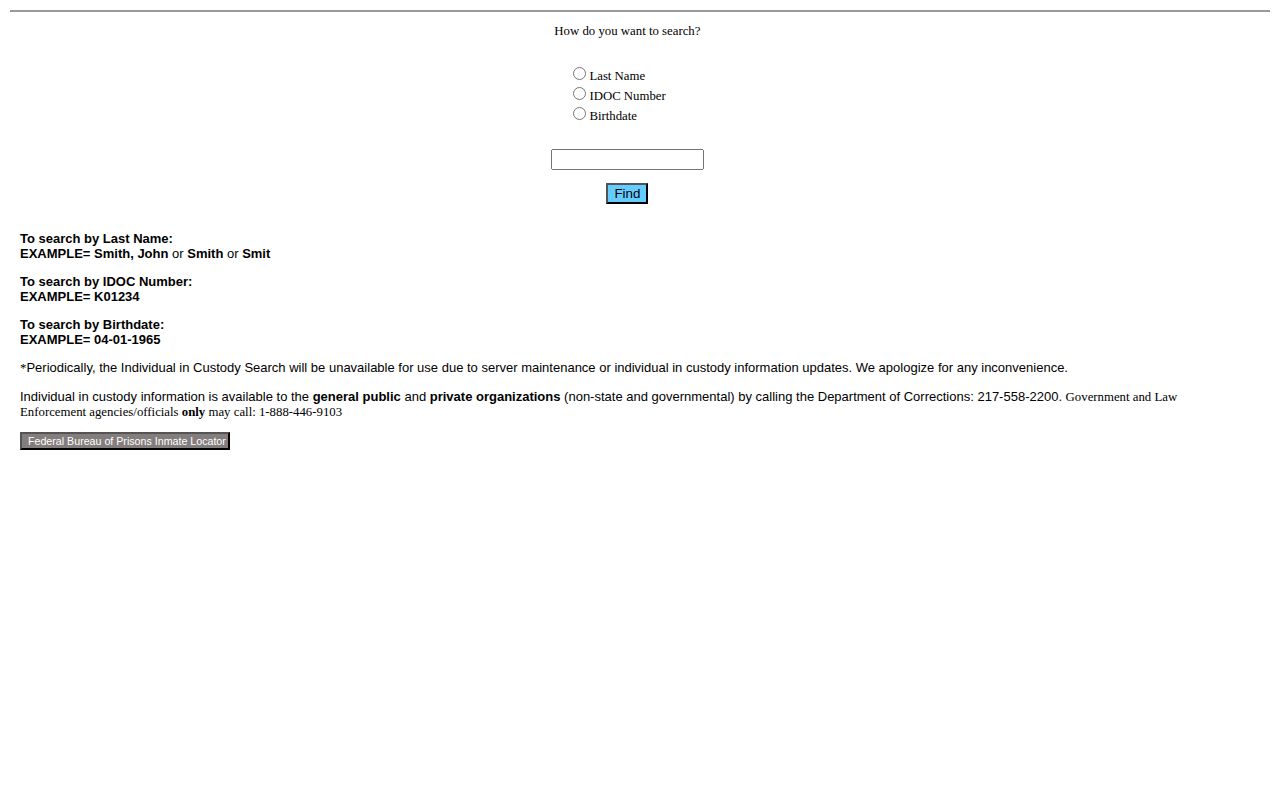
The form is useful for current and former IDOC records, but its result must be matched with more than a name alone.
Illinois Credit Rules for Calhoun
Illinois has no single rule that everyone serves 85 percent. The controlling sentence-credit statute turns on the offense, offense date, sentence structure, conduct, programs, custody credit, and later changes. For offenses outside listed exceptions, the statute generally provides one day of sentence credit for each day of imprisonment or recommitment. That is often called a 50 percent framework, but it does not guarantee release at the halfway point.
Covered first-degree murder and terrorism provisions allow no sentence credit, creating a 100 percent framework. Listed serious offenses cap ordinary credit at 4.5 days per month, commonly called the 85 percent framework. Listed serious drug provisions use a 7.5-day monthly cap, commonly called 75 percent. The offense and date of commission decide which rule applies.
Program, education, service, and discretionary earned-credit provisions add more limits. Awards can require minimum time served, participation, and administrative eligibility. Credits may be denied, lost, restored, or recalculated. Additional credit cannot take an 85 percent sentence below 85 percent. A 75 percent sentence generally cannot fall below 60 percent, except gunrunning remains at least 75 percent. A 100 percent sentence stays at 100 percent.
IDOC policy describes a calculation that begins with custody date and sentence, applies statutory credit, adjusts lost or restored time, and then subtracts eligible program awards. Two Record Office reviewers generally check it, subject to an immediate-release staffing exception. This is why a simple online calculator cannot replace the official record.
Why Calhoun Release Projections Move
A projected release date reflects the data available when IDOC calculates it. A later award, loss, court action, or custody hold can move the date. IDOC says an earned-credit revision is communicated and reflected on the public profile, making the current official result more reliable than arithmetic from a headline sentence.
| Factor | Possible effect | Where to verify |
|---|---|---|
| Earned program award | May move an eligible date earlier within statutory floors | IDOC profile and record |
| Disciplinary loss or restoration | Can move the date later or restore time | IDOC calculation record |
| Amended sentence or credit correction | Changes the inputs | Signed court order and IDOC update |
| Concurrent or consecutive interpretation | Changes how terms combine | Court judgment and IDOC calculation |
| Detainer or other hold | May turn one agency's release into a transfer | Custody entry and receiving agency |
| Revocation | May return a person to custody and require a new calculation | PRB result and IDOC status |
An indeterminate case with a PRB date uses the Board date in the IDOC process. Routine determinate MSR is different. PRB does not select the ordinary prison release date in those cases.
Note: A detainer can end one custody episode without producing community release, so the destination field must be checked.
Confirm Calhoun Actual Release
After a projected date passes, look for a later official status and an actual release or discharge entry. For IDOC, compare the current profile with public release information. For county custody, ask Calhoun for the date and time discharged or transferred, the recorded disposition, and the receiving agency when maintained and disclosable.
Illinois VINE can send custody-status notices for covered IDOC records. The VINELink Inmate Search describes that alert path, but an alert is timely notice rather than the final record. Calhoun county-jail participation must be confirmed in the live chooser or with the operator.
IDOC's official FAQ supplies release-date and earned-credit cautions.
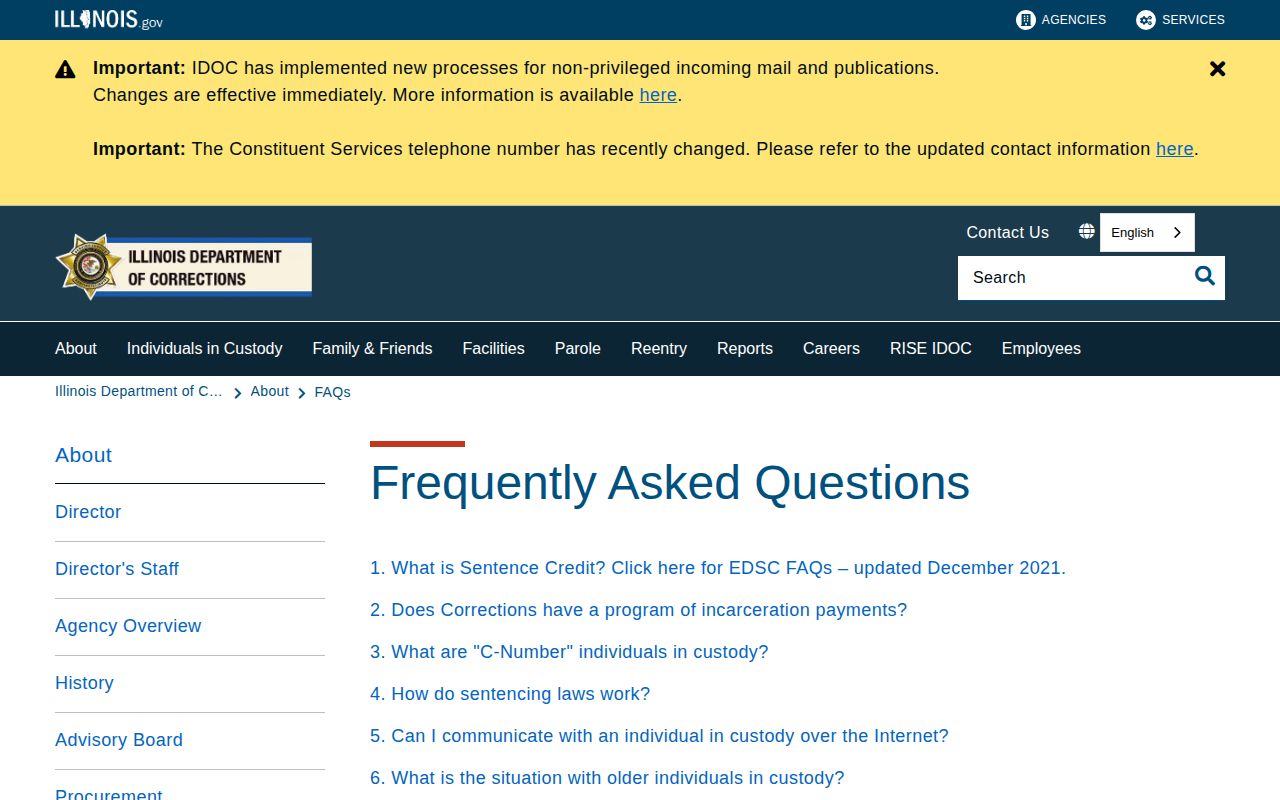
The FAQ explains why IDOC cannot promise whether or when a specific potentially eligible person will receive discretionary credit.
Calhoun County Sentence Dates
IDOC credit rules should not be applied to a county-only jail term. No current official Calhoun good-time formula or weekend-release policy was located. Obtain the signed sentencing order, including jail credit, then obtain the actual sheriff or receiving-jail chronology.
A time-served sentence can explain why no future term remained. Still, the custody record fixes the physical event. If Calhoun transferred the person, the receiver controls the later discharge timestamp. A court dismissal or release order also does not rule out another hold.
This local boundary is essential. Calhoun's compact detention system makes a two-custodian check more likely than in a county with one long-term jail. Do not assume a historical receiving contract remains current. Ask for the named receiver in the person's own record.
Note: County sentence dates come from the order and custody ledger, while IDOC projections govern state-prison records.
Read Calhoun IDOC Date Fields
The IDOC search accepts one of three starting values: last name, IDOC number, or birth date. An IDOC number is usually the strongest discriminator. A partial surname can find spelling variants, but it can also return several people. Compare the committing county, offense, sentence, admission, and lawful identity details before treating a record as a match.
Current location or status must be read beside the date fields. A former-person status with a historical release date establishes an exit from the identified IDOC episode. It does not prove the person is free from county, federal, or immigration custody, and it does not prove supervision has ended. A future projected MSR date remains a forecast. A past projected date should be checked against the later recorded status.
IDOC policy terminology comes from an internal record workflow. That policy supports the meanings of projected MSR and projected discharge, but it does not prove every public profile displays every internal field. Quote only the labels visible on the selected result. If a needed field is absent, contact IDOC Public Information at 217-558-2200 or request the existing public record rather than filling the gap through inference.
Calhoun Court Orders and Release
Judici can show charges, docket entries, disposition, sentence, hearing dates, and financial entries for public Calhoun cases. Search by party name or case number, verify the case, and read entries in order. A caption or next hearing date cannot answer when custody will end.
The signed judgment controls when shorthand is unclear. A bond or pretrial order authorizes release subject to its terms, while jail processing may finish later. A dismissal or acquittal resolves the identified charge but does not exclude another warrant or hold. A probation sentence may follow an initial jail term. A commitment order starts the path to IDOC rather than proving a prison release.
Later amendments and jail-credit corrections can change sentence inputs. Obtain the underlying order through the Calhoun Circuit Clerk when docket wording such as remand, mittimus, time served, or bond continued controls the conclusion. Then check whether IDOC updated the projected date. The clerk supplies the legal order; the custodian supplies the actual exit time.