
Calhoun Probation Versus Parole
Probation is a sentence entered by the circuit court. It can follow a guilty finding or plea without a state-prison term, though an order may also include an initial jail component. The public sentencing order is the best starting point. Calhoun County probation staff supervise that court sentence, but public records do not create an open name-by-name probation roster.
Parole and mandatory supervised release, often shortened to MSR, follow IDOC custody. IDOC Parole Field Operations performs community supervision. The Illinois Prisoner Review Board, or PRB, sets conditions and conducts defined hearings. Most modern determinate prison terms lead to MSR by law after the prison portion. Traditional discretionary parole chiefly concerns older indeterminate sentences, while youthful parole has its own statutory route.
| Form | How it begins | Authority | Best public evidence |
|---|---|---|---|
| Probation | Calhoun County court sentence | Local probation office and sentencing court | Judgment or sentencing order |
| MSR | Release after the prison portion of a determinate IDOC sentence | IDOC Field Operations; conditions set by PRB | IDOC status and release dates |
| Parole | Board-authorized release in an eligible case | PRB and IDOC Field Operations | IDOC record plus applicable PRB result |
| Final discharge | Supervision term ends or PRB grants early final discharge | IDOC or PRB, as applicable | Current status or final-discharge order |
A county court's conditional-discharge order is another court disposition. It is not the same as IDOC final discharge. Read the issuing agency and record date before assigning a supervision label.
Verify Calhoun Post-Release Supervision
Start with the record that created the status. For Calhoun County probation, that is the criminal judgment. For state parole or MSR, it is the IDOC record, read with a PRB calendar or decision only when the Board has a role in that case. No official general parole-agent locator by a person's name was found, so a search should not promise an agent assignment.
- Open the Calhoun Judici court portal. Match the person and case, then inspect the judgment, sentence, probation, conditional-discharge, and later modification entries.
- If the sentence includes IDOC, use the IDOC Individual in Custody Search. Search by IDOC number when known, or use last name or birth date. Compare admission, release, sentence, and current status details.
- Check the PRB hearing hub only for the relevant proceeding. Parole interviews, en banc votes, revocation matters, and discharge decisions are separate records.
- Contact Calhoun Probation about its procedure after a court order confirms probation. For parole or MSR routing, contact IDOC or PRB without asking for private case-management details.
- Save the dated official result. A later warrant, revocation decision, resumed release, or final discharge may change the supervision status.
The main Calhoun County released-inmate search helps reconstruct the earlier custody event. Supervision verification begins only after the correct release path and sentence are known.
Note: A court hearing date alone does not establish probation, and a PRB docket entry is not a final parole or revocation result.
Calhoun County Probation Office
Calhoun County has a named local probation office. It handles court probation, not IDOC parole or MSR. A public sentencing order should establish that the person was placed on probation before an inquiry is made. Ask how a public supervision status or court record can be confirmed, not for confidential reports, treatment details, or an officer's case notes.
Chief Probation Officer Ashley Campbell
101 N. Main Street
Hardin, IL 62047
618-576-9032
ashley.campbell@calhouncountyil.gov
Monday through Friday, 8 a.m. to 4 p.m.
State supervision follows another chain. IDOC Public Information can be reached at 217-558-2200, with correspondence sent to 1301 Concordia Court, P.O. Box 19277, Springfield, IL 62794-9277. PRB Operations is available at 217-782-7273 or prb.operations@illinois.gov. Those contacts can route record questions, but neither source offers a broad public agent-by-name lookup.
Calhoun Supervision Violations Explained
Conditions are rules attached to community supervision. Their source matters. A Calhoun County judge sets probation terms through the court order. PRB sets conditions for parole or MSR, while IDOC Field Operations supervises compliance. A violation allegation means the agency claims a rule was broken. It is not the same as a final finding.
An absconder is a supervised person alleged to have stopped reporting or left supervision without authorization. A warrant may lead to arrest, but neither an old social post nor a name disappearing from a list proves current warrant status. Review the court docket for probation proceedings. For parole/MSR, compare the IDOC status with the PRB revocation schedule and the separate revocation results.
The result vocabulary should be preserved. PRB may resume release, change conditions, or revoke release. A deferred matter is not a denial unless the decision says so. When release is revoked, IDOC calculates the resulting custody time and revised release date.
The official PRB results page shows why the decision page, not a pending docket alone, is needed.
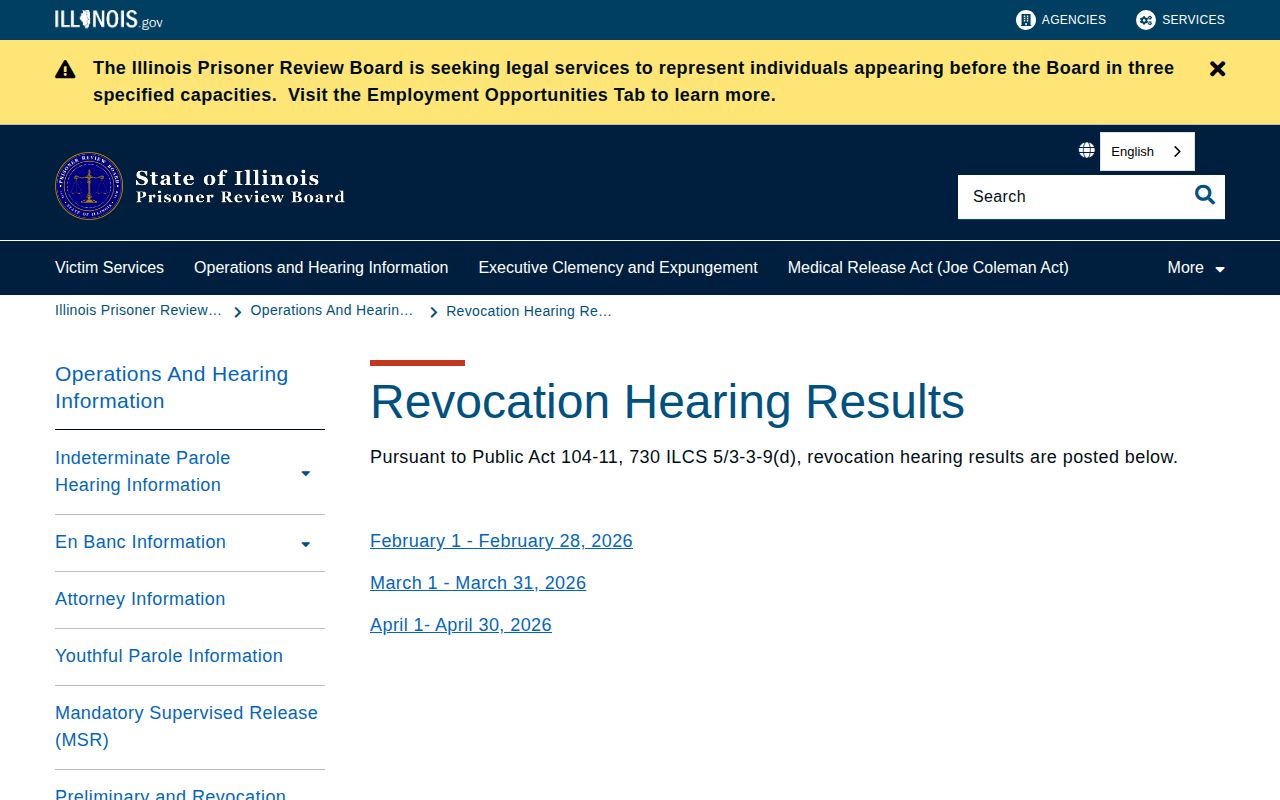
The dated heading and exact outcome should be recorded because a later custody or discharge event may supersede an older result.
When Calhoun Supervision Ends
Completion of probation is documented through the court case and local records. Completion of parole or MSR is an IDOC matter. Final discharge means the supervision obligation has ended. It must not be confused with the earlier day a person left a secure prison for community supervision.
PRB may consider early final discharge using compliance, programming, risk and needs information, case factors, public safety, and an IDOC recommendation. The early final discharge process is therefore distinct from routine sentence calculation. An order granting discharge is stronger evidence that parole or MSR ended than an old projected prison date.
The official discharge page outlines the Board's role and should be checked for current procedure.
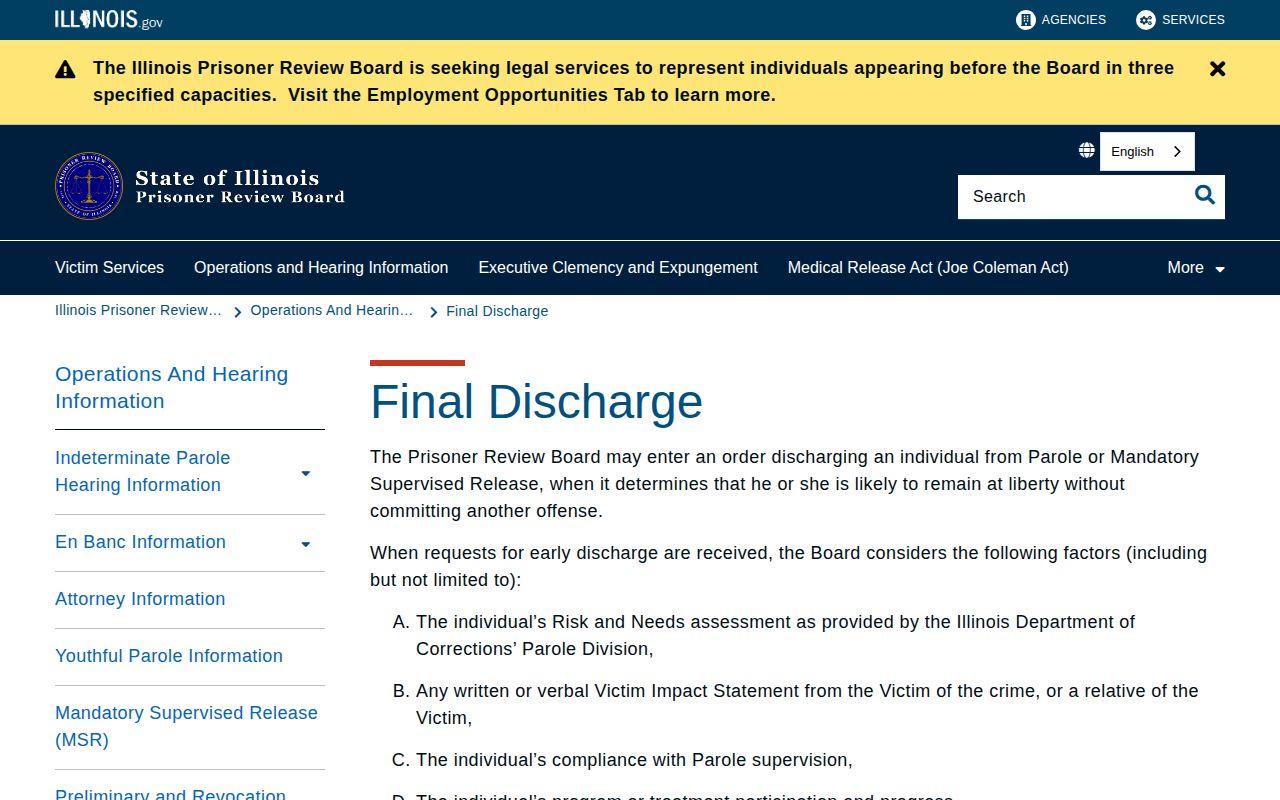
Use the order date and exact terms. If a request concerns older supervision, historical PRB minutes and the current IDOC status can help reconcile later changes.
Note: Prison release, release to MSR, and final discharge are three different events and may carry three different dates.
Which Calhoun Office Has It?
Calhoun County's local office and the state supervision agencies maintain different records. This is the county's distinctive supervision issue. A probation judgment does not establish an IDOC release, and an IDOC profile does not show that a Calhoun judge imposed probation. Start with the system named in the sentence.
- Probation
- A community sentence imposed by the court and supervised locally.
- Mandatory supervised release
- A required supervision period after the prison portion of many determinate IDOC sentences.
- Parole
- Board-authorized community release in a case legally eligible for discretionary parole.
- Revocation
- A decision withdrawing community release after the applicable process.
- Final discharge
- The formal end of parole or MSR supervision.
For an older indeterminate sentence, the PRB annual en banc schedule identifies full-Board meeting dates, current results state what occurred in listed matters, and historical minutes support older research. Youthful-parole eligibility depends on age at offense, sentence date, offense, term, and exclusions under Illinois law. No result should be predicted from age alone.
Note: Calhoun Probation confirms local court supervision procedure; IDOC and PRB route state parole and MSR record questions.
Read Calhoun Parole Hearing Records
PRB publishes several calendars and result sets, each with a narrow purpose. The monthly hub identifies scheduled Board work. Parole-interview schedules concern eligible parole reviews. Annual en banc dates show when the full Board meets, while current decisions and historical minutes show outcomes. Revocation schedules and revocation results form another pair. Mixing these sources can turn a pending matter into a false final status.
En banc review chiefly applies to indeterminate and specified youthful matters. Under 730 ILCS 5/3-3-3, eligible older indeterminate cases follow calculated minimums and Board-set review intervals. People serving modern determinate sentences generally serve the prison term less applicable credit and then enter MSR by law. PRB does not choose the routine MSR release date.
Outcome words must remain exact. A grant may require conditions or an approved release plan. A revocation result can resume release, alter conditions, or revoke release. Deferral moves a decision without necessarily denying it. Always note the date and heading of the record because later proceedings can change the person's status.
The current en banc decisions illustrate the result source that follows the schedule.
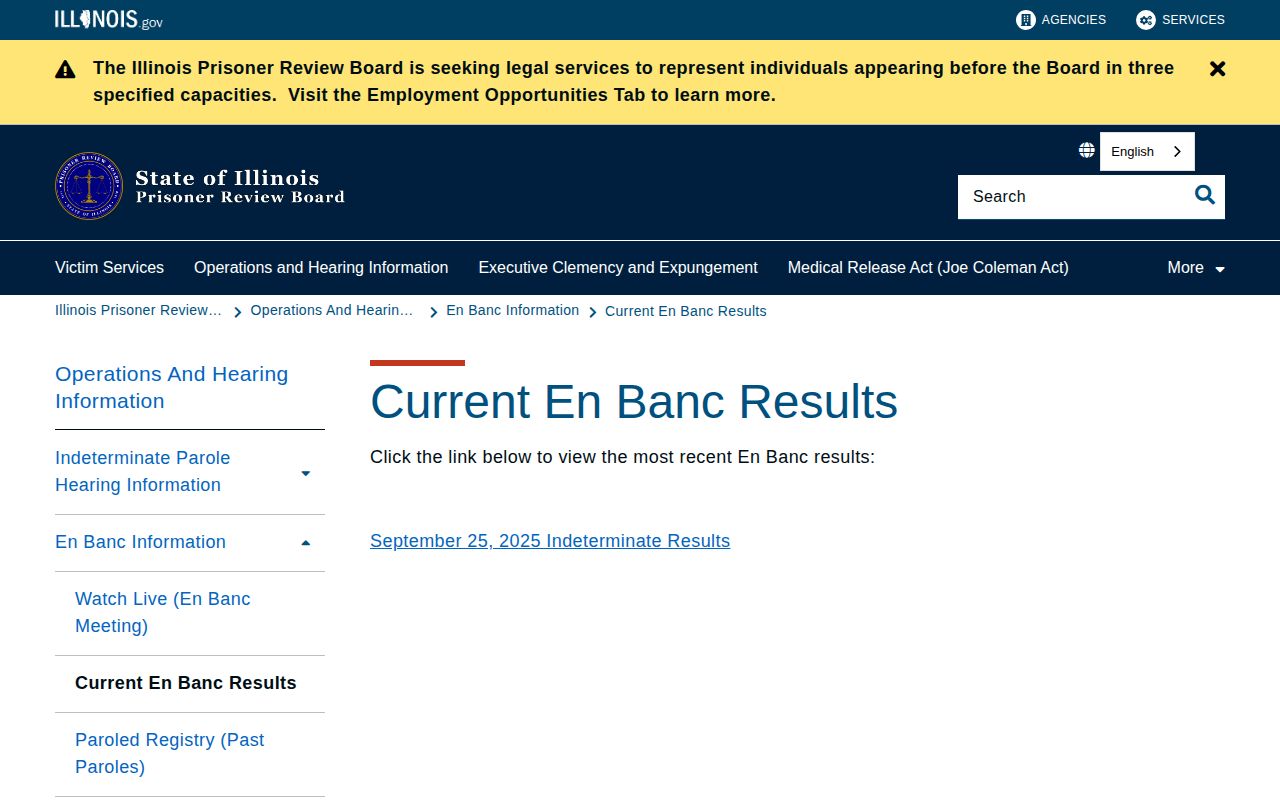
The decision should be paired with the current IDOC record before stating whether supervision or custody remains active.
Calhoun Supervision Change Notices
Illinois VINE can provide covered IDOC custody-status and transfer notices by email, text, phone call, or mobile application. An alert is useful notice, but it does not replace an IDOC status or PRB decision. Calhoun county-jail participation has not been confirmed, so state-prison coverage must not be generalized to every local custody episode.
PRB notification is a separate enrollment. It can cover specified events such as release on parole or MSR, electronic detention, work release, certain transfers, hearings, target dates, and discharge orders. Registration with VINE does not register a person for PRB notices. Eligible recipients should use the PRB notification service or call 800-801-9110.
Save the notice with its agency and date, then verify the event. A transfer alert does not mean release to the community. A discharge order concerns the end of supervision, while a prison release notice may mark only the start of MSR.