
IDOC Release Destinations
An IDOC prison release may lead to mandatory supervised release, known as MSR, limited statutory parole, or final discharge. MSR is the period of state supervision that usually follows a determinate Illinois prison term. Leaving a secure institution on MSR does not mean the sentence and all supervision have ended. Final discharge is the later end of IDOC authority shown by the applicable record.
No IDOC prison is located in Calhoun County. A local case enters IDOC through a court commitment and transfer. The Calhoun record documents the handoff, while IDOC documents state admission, parent institution, status, sentence, and later release information. If the IDOC profile does not match the committing county or sentence, do not assume it concerns the same episode.
| Event | Meaning | Best record |
|---|---|---|
| County commitment | Court orders a state prison term | Signed Calhoun sentencing order |
| IDOC admission | State custody begins | IDOC profile and admission record |
| Projected MSR | Expected prison-to-supervision point | Current IDOC calculation |
| Projected discharge | Expected end of IDOC sentence authority | Current IDOC profile |
| Actual discharge | Completed state custody or supervision event | Later status and release record |
Search IDOC Calhoun Releases
The official IDOC Individual in Custody Search leads to the live form. It accepts one of three search keys: last name, IDOC number, or date of birth. An IDOC number is usually the strongest discriminator. A partial surname can help with variants but can also produce unrelated matches.
- Open the official IDOC search and continue to the live form.
- Enter the IDOC number when known. Otherwise use a surname or birth date.
- Open the likely result and compare name, vital details, committing county, offense, and sentence.
- Read current location or status together with admission and release dates.
- Preserve “projected” on any future date and verify an old projection against later status.
The official IDOC search landing shown below directs users into the state form.
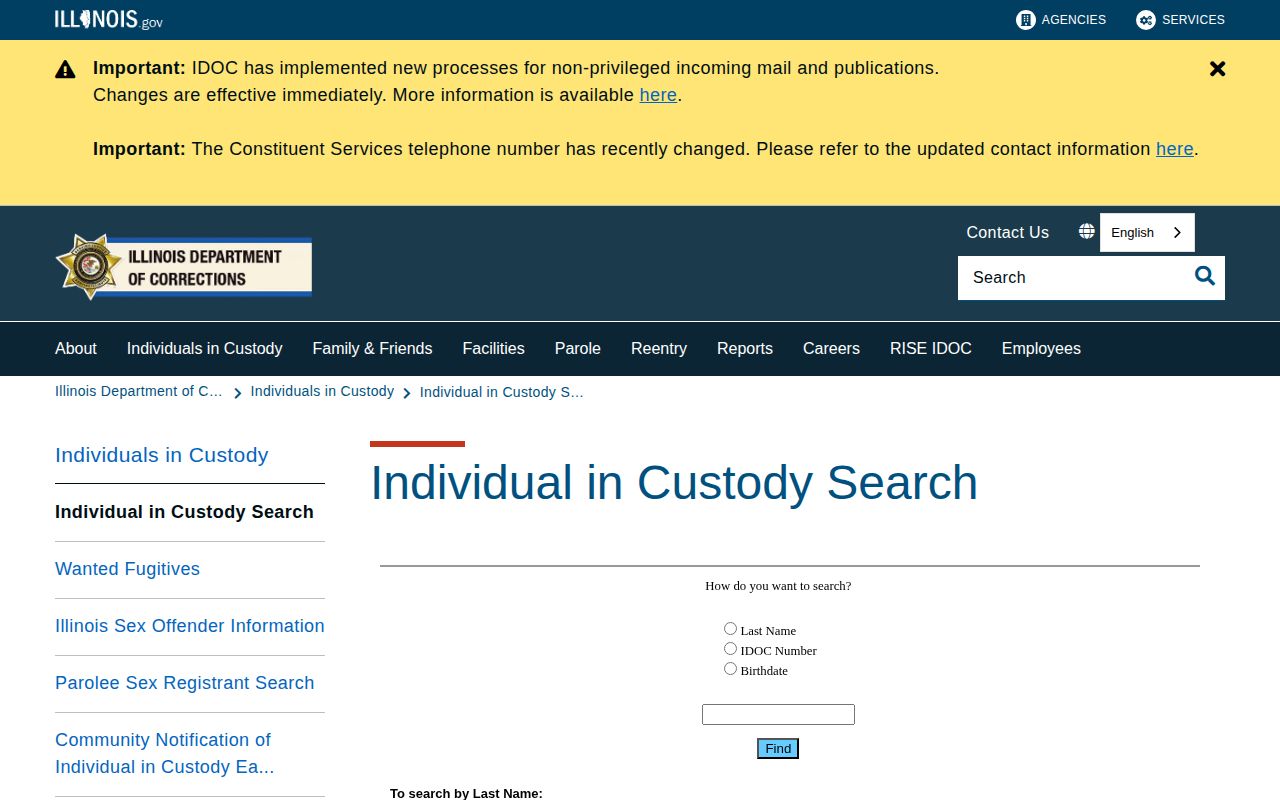
The image confirms the state search route. Exact result wording must still be read from the selected public profile.
IDOC Release Search Fields
IDOC says public information for current or former people can include name, IDOC number, parent institution, current location or status, vital statistics, admission and release dates, and sentencing information. Internal policy also uses committing county, current admit date, sentence, crime, release county, projected MSR date, and projected discharge date. Internal terminology does not prove that each field appears on every public result.
- PROJ MSR DATE
- The projected date for leaving prison and entering mandatory supervised release.
- PROJ DISC DATE
- The projected end of the IDOC sentence or supervision period.
- Former-person status
- A status category for someone no longer held as a current IDOC prisoner; use the profile's exact wording.
- Parent institution
- The IDOC institution assigned in the state record, which may differ from a present physical location.
Search results are identity-sensitive. Compare more than a name. The same surname can belong to several people, and a Calhoun connection does not prove that every Illinois sentence on the profile arose from the local episode.
IDOC Projected Release Limits
A projected release date can change. Illinois has no universal rule that every prisoner serves 85 percent. Under 730 ILCS 5/3-6-3, the offense, offense date, sentence form, statutory credit category, custody credit, conduct, program awards, and later court changes all matter. Some covered offenses have a 100 percent framework, some use restricted 85 or 75 percent credit rules, and other offenses generally receive day-for-day statutory credit.
Additional credit cannot override statutory floors. Credits may be awarded, denied, lost, restored, or recalculated. Concurrent and consecutive sentences can also change the result. IDOC states that predicting if or when a specific discretionary award will occur is not possible, so a private arithmetic estimate cannot replace the official record.
IDOC Parole and MSR
Most determinate Illinois prisoners enter MSR by operation of law after the prison portion of the sentence. The Prisoner Review Board sets conditions and hears specified matters, while IDOC Parole Field Operations supervises the person. Traditional discretionary parole remains relevant to limited eligible categories, including certain older indeterminate sentences and qualifying youthful-parole cases.
A parole hearing is not part of every IDOC release. The Illinois Parole Hearings page separates monthly interview calendars, full-Board decisions, revocation proceedings, and early final discharge. For a routine status check, begin with IDOC. Use a Board result only when the person and proceeding are actually listed.
Revocation means the Board is considering or has decided whether supervised release should be withdrawn due to an alleged violation. A schedule proves only that a proceeding was set. The result supplies the outcome. If release is revoked, IDOC recalculates the resulting custody dates.
IDOC Release Records Contact
The public locator is the first route. When an official record is needed, identify the person by IDOC number and ask for public admission, release, status, and sentence information. Requests for confidential master-record calculations may be limited. Keep the request tied to existing public fields and a defined date or event.
Illinois Department of CorrectionsPublic Information
1301 Concordia Court
P.O. Box 19277
Springfield, IL 62794-9277
217-558-2200
The separate 888 number displayed in some search materials is for government and law-enforcement use. General users should not be routed to it. The IDOC FAQ explains the available public information and limits on release-date predictions.
The official FAQ is captured below from its IDOC source page.
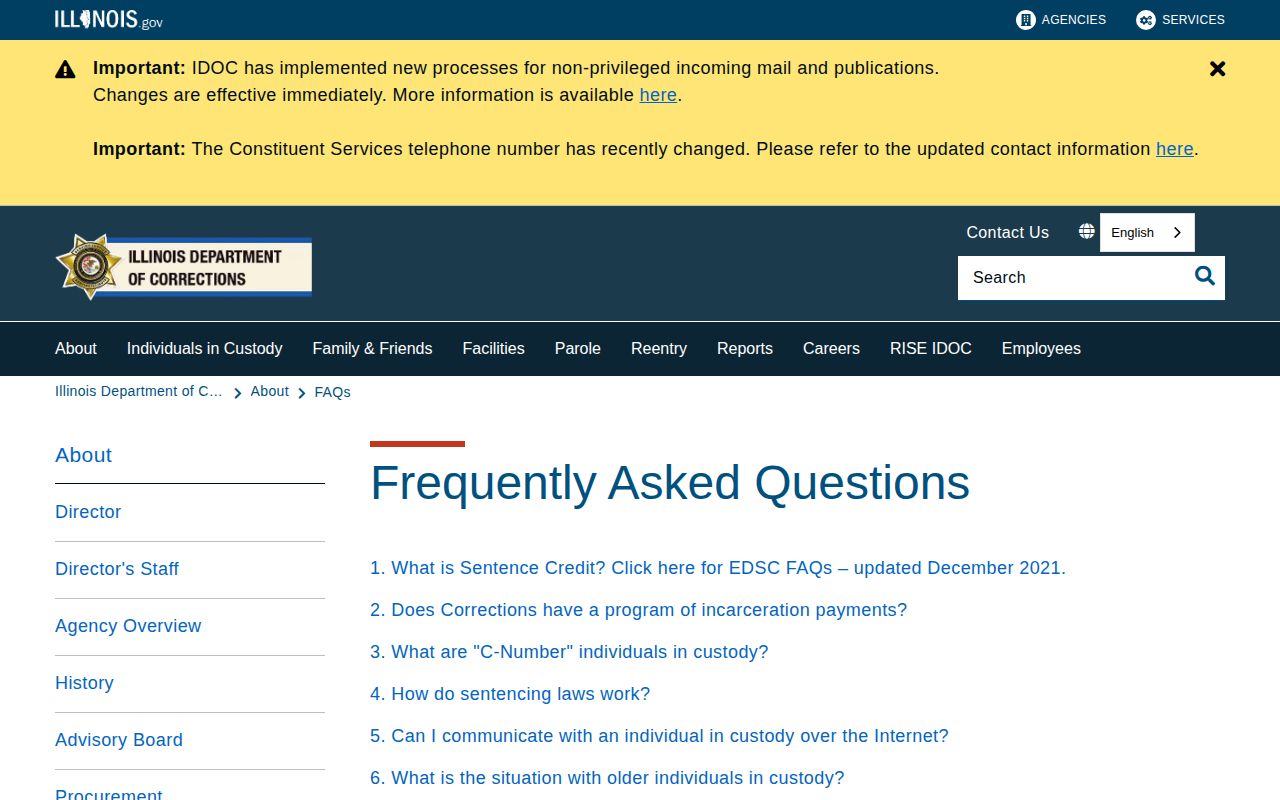
Its guidance supports using the current agency record rather than promising a date from sentence length alone.
IDOC and County Records
The Calhoun court order and IDOC record answer different parts of the chain. The court establishes the sentence. The sheriff records local custody and transfer. IDOC records state admission and later state release. Judici may show the local docket, but the signed order is the better source when shorthand terms such as remanded, mittimus stayed, or credit for time served control the conclusion.
If a result is absent, check spelling and identifiers before drawing an inference. Restricted, sealed, or expunged county information may affect public visibility. An empty search does not prove no custody occurred. For the full cross-system route, use the Calhoun County release search, which also covers county, court, federal, immigration, and records-request channels.
County-only sentences require a different method. Do not apply an IDOC credit formula to a term served in a county or receiving jail. Use the signed sentencing order, jail-credit entry, and actual sheriff or receiver discharge record. Those records can also show whether another hold delayed physical release after the local term ended.
Record the date of each official status check.