
Illinois Parole Release Paths
The Illinois Prisoner Review Board, or PRB, sets release conditions, conducts specified hearings, handles revocation matters, and considers early final discharge. IDOC Parole Field Operations supervises people on parole or mandatory supervised release. These are statewide systems. They are not a jail or parole office located in Calhoun County.
Most people serving determinate Illinois terms reach mandatory supervised release under the sentence and credit framework. PRB does not cast a discretionary vote on each routine release date. Traditional parole hearings concern limited eligible groups, including certain pre-1978 indeterminate sentences. A separate youthful-parole law creates review routes for qualifying cases based on age, sentencing date, offense, term, and exclusions.
| PRB record | What it shows | What it does not prove |
|---|---|---|
| Interview schedule | A planned parole interview | That parole was granted |
| En banc schedule | Date for a full-Board session | A person's final outcome |
| Current decision | Recorded Board action in a listed matter | That all conditions were completed |
| Revocation schedule | An alleged violation proceeding | A final violation finding |
| Final-discharge order | End of parole or MSR supervision | The earlier prison-door date |
Search Illinois Parole Decisions
Start with the IDOC profile. Match the person, IDOC number, status, sentence, and dates. Next open the PRB hearing hub and select the record type that fits the issue. Monthly interview lists, annual en banc dates, current decisions, historical minutes, past-parole records, revocation schedules, and revocation results are separate sources.
- Confirm the IDOC identity and determine whether the issue is parole, MSR, revocation, or final discharge.
- Open the matching PRB calendar and note its posted month or capture date.
- Match the IDOC number and proceeding, not only a name.
- Find the later decision or result. Do not stop at the schedule.
- Recheck the current IDOC status because a later event can change custody or supervision.
PRB pages change as new monthly files and decisions appear. Date every finding. Historical minutes may answer an older question, while the current profile answers present status.
Illinois En Banc Decisions
“En banc” means the full Board considers and votes on the listed matter. These sessions apply to defined indeterminate and youthful cases, not all Illinois releases. The annual calendar answers when sessions are planned. Current results answer what the Board recorded in identified matters. Historical minutes can preserve earlier actions when a current page has moved on.
The current en banc decisions page captured below illustrates the official result channel.
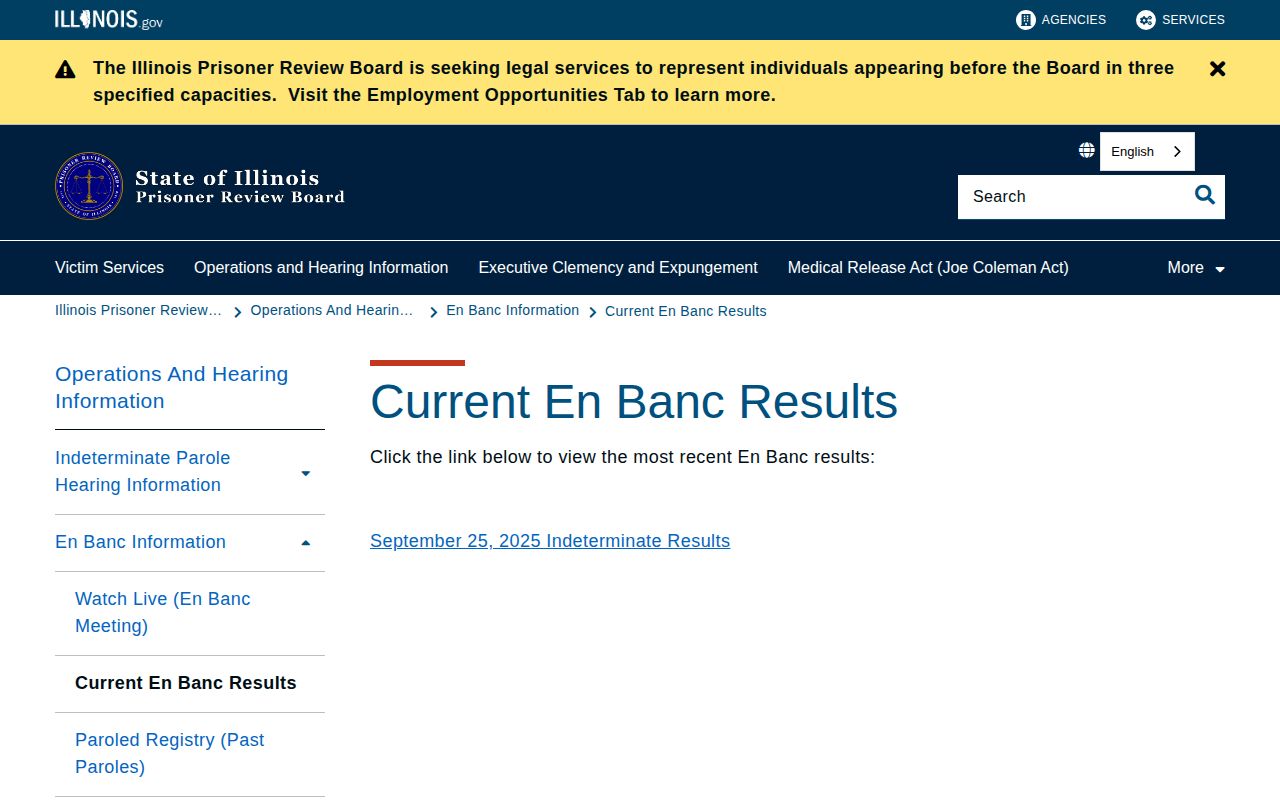
The capture must be read with its heading and date. It does not function as a permanent current-status locator.
- Granted
- The Board approved release in the proceeding, potentially subject to conditions and an approved plan.
- Denied
- The Board did not approve release in that proceeding.
- Deferred
- The matter was postponed or held for later action; it is not a denial unless the result says so.
- En banc
- A proceeding decided by the full Board rather than a single hearing officer.
Illinois Revocation Hearing Results
A revocation case concerns an alleged violation after release to parole or MSR. Being placed on a revocation schedule does not prove the allegation or predict the outcome. The separate result may resume release, change conditions, continue the matter, or revoke release. If revoked, IDOC calculates the resulting custody time and later release date.
The official revocation schedule and revocation results should be used together. A later IDOC profile check is still needed. A result that restored release may require placement or other conditions before physical departure.
The PRB revocation result source shown here is proceeding-specific.
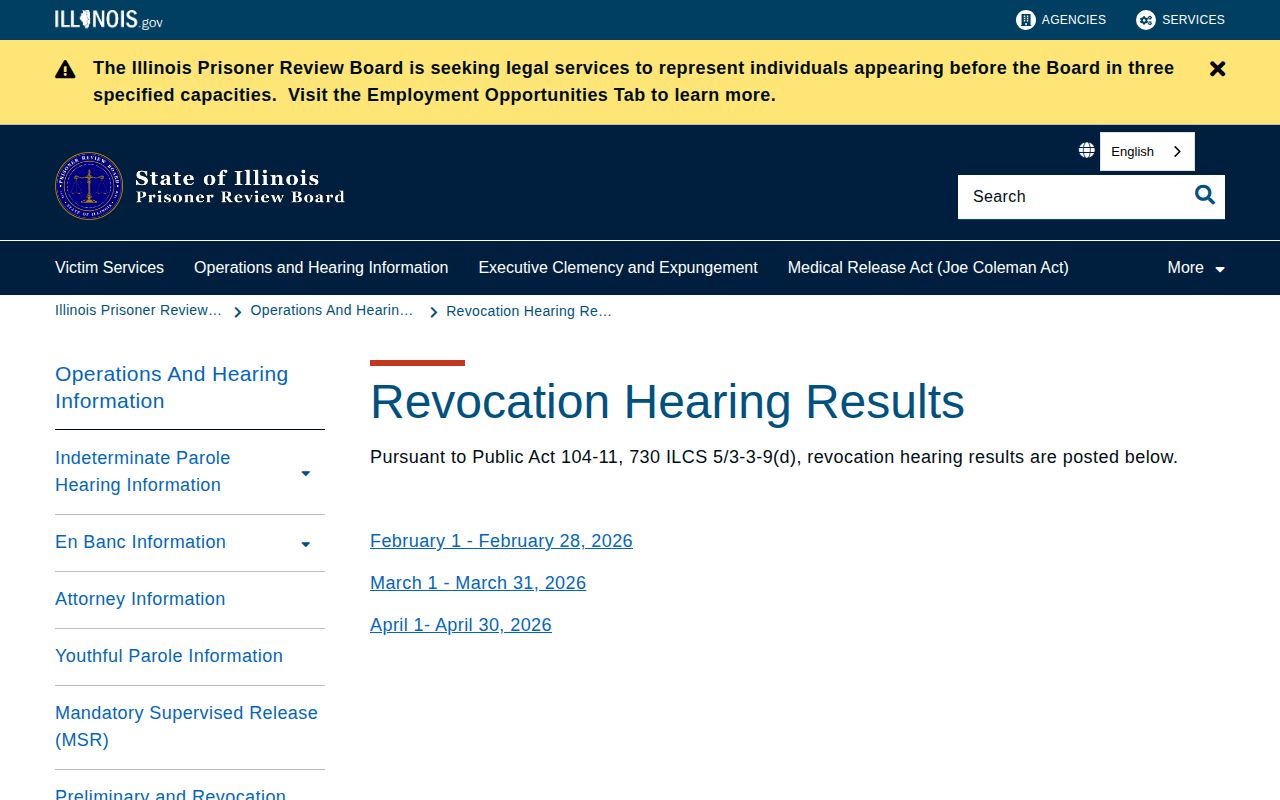
Its outcome language should be preserved instead of reducing every entry to granted or denied parole.
Illinois Final Discharge Records
Final discharge ends state parole or MSR supervision. It is distinct from the earlier date a person left prison. PRB may consider early final discharge based on risk and needs information, compliance, programs, case factors, public safety, and an IDOC recommendation. A formal discharge order is stronger proof that supervision ended than an old projected date.
Use the PRB early final discharge page for this record type. The official capture below shows the dedicated channel.
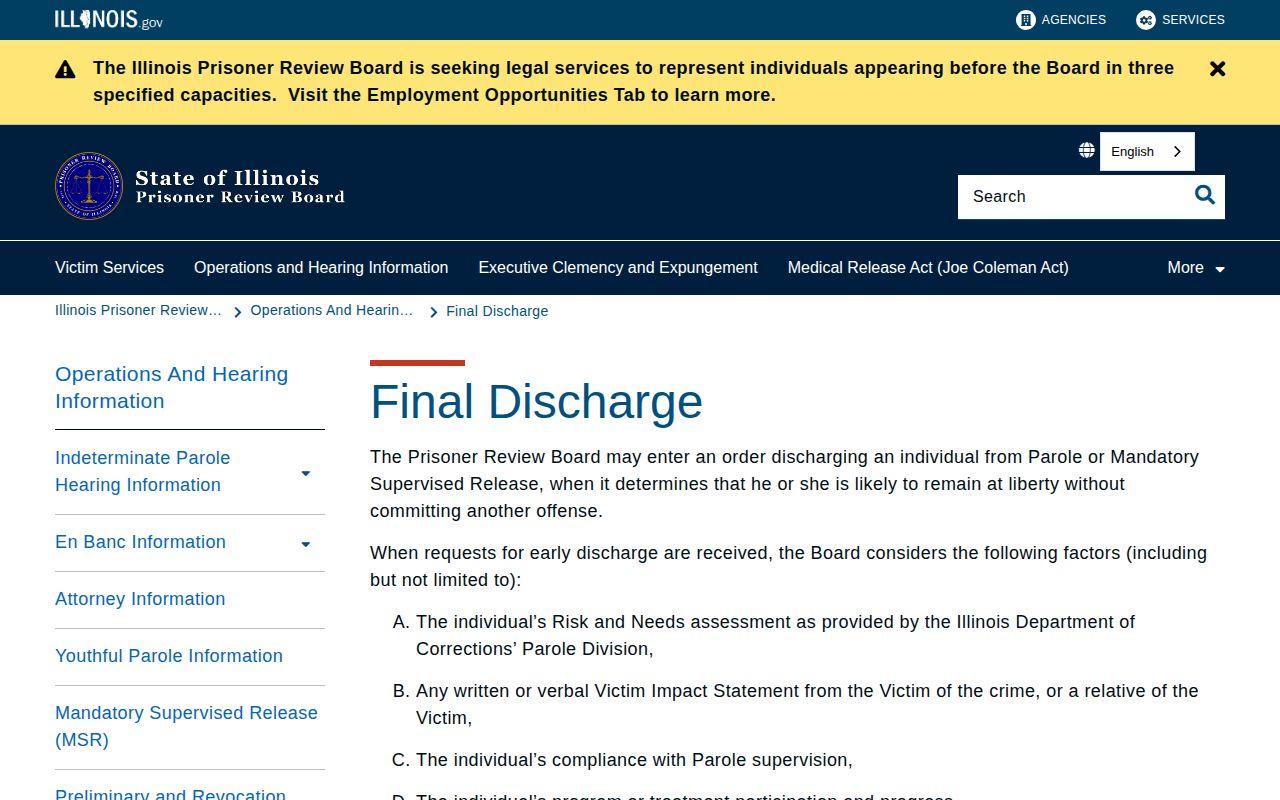
The page concerns ending supervision. It should not be cited as proof of the original prison release time.
Calhoun Parole Record Boundaries
Calhoun County probation is separate. Probation is a court sentence supervised by the local probation office. Parole and MSR follow state prison custody and are supervised by IDOC. A Calhoun probation judgment should not be relabeled as an IDOC release status, and a local probation contact is not a public parolee search.
For a named Calhoun case, compare the signed sentencing order, IDOC status, and any PRB proceeding. If the court imposed probation, use the Probation & Parole page and local court route. If the court committed the person to IDOC, use the state profile first.
Eligibility also requires care. Under 730 ILCS 5/3-3-3, covered indeterminate cases become eligible after the calculated minimum and return at Board-set intervals. Youthful review under 730 ILCS 5/5-4.5-115 depends on several statutory facts. Age alone does not establish eligibility.
Illinois Parole Records Contact
PRB Operations can route questions about Board records and proceedings. Give the IDOC number, proceeding type, and relevant month or year. Do not ask the Board to predict release from a sentence headline. If supervision status is the question, begin with the current IDOC record and use the formal decision that matches the event.
Illinois Prisoner Review Board OperationsPhone: 217-782-7273
Email: prb.operations@illinois.gov
PRB notification is a separate enrollment for eligible recipients and specified events. It does not function as a general public person-search database. The VINELink Inmate Search also uses a separate registration. Enrollment in one does not enroll a person in the other.
The program can cover identified hearings, target dates, release types, and discharge orders for eligible recipients. Automated custody alerts serve a different role. Neither replaces a signed decision or the current IDOC status. Save the date and title of each source because a later action can change the answer.
When a result says release may resume, read all stated conditions. An approved host site, treatment placement, or plan may be required before departure. A favorable vote and the physical release date can differ. Ask IDOC to confirm the custody event instead of assigning the meeting date as release.
Older proceedings require historical minutes and past-parole materials. Search with the IDOC number and relevant year, then check current status. Historical approval does not rule out a later violation or custody episode. Preserve exact outcome terms rather than treating every Board matter as a new parole grant.
Record the date of each official status check.