
Calhoun Federal Release Paths
No federal prison was identified in Calhoun County. Federal custody can still follow a local arrest, federal writ, indictment, or court order. Calhoun may record an outgoing handoff, but the federal agency controls the later custody event. The record chain can involve a county jail, USMS transport, a contract detention site, BOP admission, supervised release, and final sentence completion.
BOP and USMS answer different questions. BOP's public locator is the main route for sentenced federal prisoners from 1982 forward. USMS does not offer an equivalent public detainee locator for many pretrial movements. The federal docket may show detention and release orders, while a focused USMS records request can seek movement information.
| Federal source | Best use | Key limit |
|---|---|---|
| BOP locator | Sentenced federal custody and recorded release date | Not a complete USMS pretrial locator |
| Federal docket | Detention, sentence, and supervised-release orders | Order time may differ from physical processing |
| USMS records | Federal detainee custody and movement | Requires a focused request; disclosure limits apply |
| Calhoun record | Local intake and handoff | Does not establish later federal release |
Search Calhoun BOP Releases
The official BOP Inmate Locator covers federal people from 1982 to the present. Search by register number when known because it is more precise than a common name. Results can include name, register number, age, race, sex, release date, and location or status.
- Open the BOP locator and choose number or name search.
- Use the register number if a docket or prior record provides it.
- Otherwise enter the full name and compare identity fields.
- Read the release date with the location or status wording.
- Check the federal docket and other custody systems before describing community release.
The official BOP locator shown below is the correct public search for sentenced federal custody.
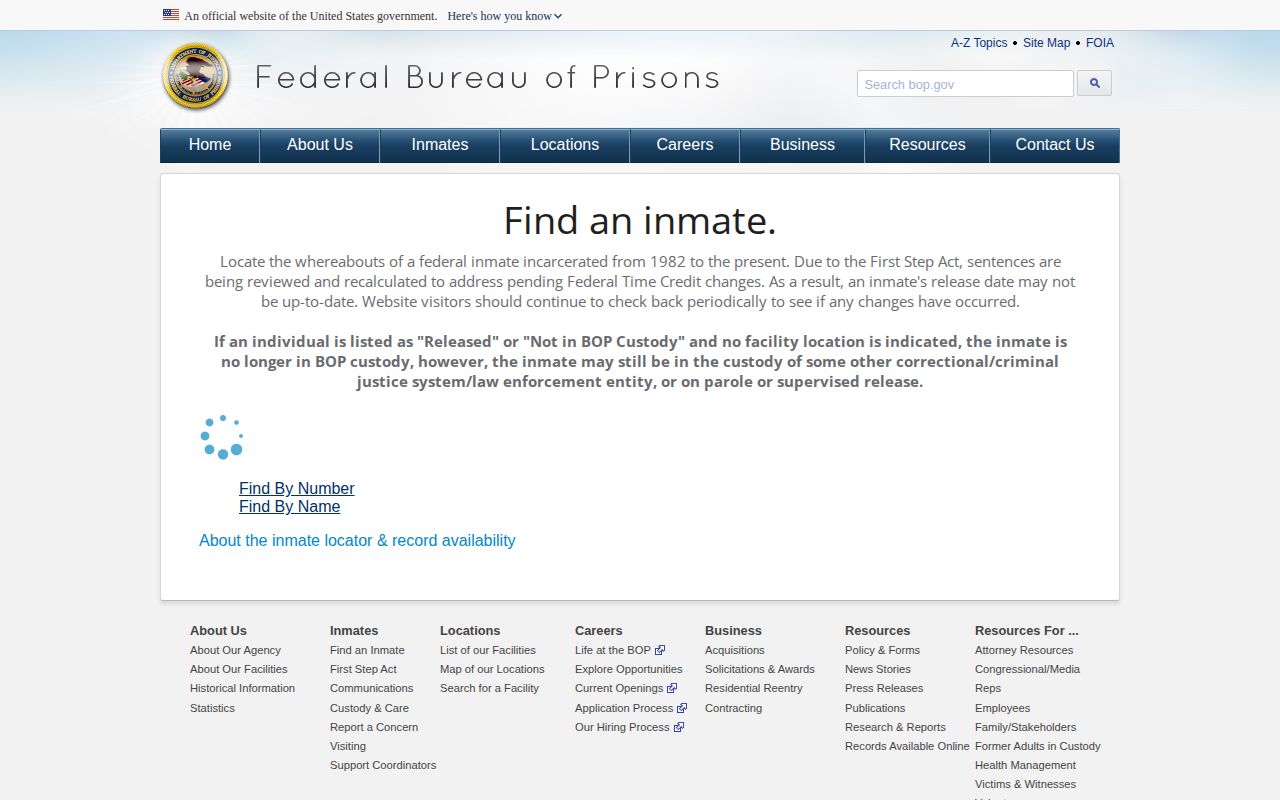
A displayed “Released” or “Not in BOP Custody” result establishes that the person is outside BOP custody. It does not establish freedom from state, local, ICE, or supervision obligations.
BOP Release Status Limits
A BOP release date may change when federal sentence credits or calculations change. Treat a future date as projected unless the record establishes the event has occurred. The federal judgment and BOP record should be read together. A court sentence sets legal terms, while BOP applies federal custody and credit calculations.
Federal supervised release is a court-ordered period after prison. It is not the same as Illinois parole, MSR, or Calhoun probation. A person listed as released by BOP may still report to federal probation under the judgment. Conversely, someone can leave a contract jail because USMS moved the person to another detention site without any community release.
- Released from BOP
- Outside Bureau of Prisons custody, subject to other possible custody or supervision.
- Supervised release
- Federal court supervision after imprisonment.
- Federal detainer
- A federal custody interest that can affect release from another agency.
- Writ
- A court order that can move a person temporarily for federal proceedings.
Calhoun USMS Custody Transfers
USMS commonly manages federal detainees before trial and during transport. It can use contract jail space outside Calhoun County. A person may vanish from a local roster because of a federal transfer. That is not evidence that a judge released the person.
First request Calhoun's outgoing event and destination if maintained. Then inspect the federal docket for detention, bond, release, or remand orders. If exact movement matters, use the USMS Freedom of Information Act route. Supply full identity, a narrow custody range, the district or case number, and the precise custody or movement records sought.
USMS explains its prisoner role on the federal prisoner operations page. Its limits on public photos and custody details are federal policy issues, not Illinois county FOIA rules. A denied or redacted response should be described by the cited basis rather than treated as proof that no federal custody occurred.
Confirm Federal Community Release
A strong conclusion uses at least two independent sources. Match the BOP or USMS identity to the federal case, then read the latest custody and court events. If Calhoun held the person first, preserve its transfer time as a separate event. If BOP shows release, review whether the judgment imposes supervised release. If ICE later assumed custody, the federal release is only the first of two custody endings.
For a county-origin case, the Calhoun County release search explains how to connect the sheriff entry, court result, and later custodian. The ICE Releases page covers a later immigration handoff.
Federal Release Record Requests
A well-scoped request asks an agency only for records it maintains. Calhoun can supply its local booking and handoff. USMS can address federal detention movement. BOP can address sentenced custody and release information. The federal court can supply public orders and the judgment. Sending one broad request to the wrong office creates delay and may produce an incomplete answer.
Identify the person with full name, birth date or register number when appropriate, case number, and a short date range. Ask for native electronic records where feasible. State that existing records are sought and no new explanation needs to be created. If another agency owns the record, preserve the referral and send a focused request there.
Older cases also require date care. BOP's public locator reaches back to 1982. An older or absent result may require archived federal court research or agency records. A missing BOP match does not prove the person was never held by USMS or another federal component.
Calhoun Federal Record Checks
Names alone are weak identifiers. Compare register number, age, sex, offense, district, and court docket facts. A matching Calhoun surname does not link a federal record to the local event. Likewise, a federal court release order authorizes release subject to conditions but may not state when administrative processing ended.
Keep terms exact. “Remanded” means returned to custody. “Released on conditions” describes a court status. “Transferred” describes a custody handoff. “Sentence complete” differs from release to federal supervision. When wording controls the conclusion, obtain the signed order and later agency record.
A federal detention order and physical custody event can occur at different times. Court minutes may summarize the judge's order, but transport, processing, or another hold can affect the later event. Match the order to BOP, USMS, local, or ICE records instead of relying on docket shorthand alone.
A verbal routing answer can identify the current custodian, but follow it with a written record when the exact date matters. Note the agency unit, call time, and substance, then request the existing movement or release record from the office that owns it.